A couple weeks ago I read a post by another creator. The post was about how they instinctively avoided topics in which they felt a high level of uncertainty, and they cited astrophysics as an example of a field of certainty.
This struck me as an odd choice due to what I learnt way back in my first year physics lab.
Uncertainty is simply inescapable when conducting science. Let me explain. I promise not to get philosophical about it.
The basic flow of a scientific study is straightforward.
- Form an hypothesis
- Conduct an experiment and measure the outcome
- Reject the hypothesis if it contradicted by the experiment
Now, what does it mean to ‘measure’ something? The answer depends on what you are trying to measure.
If you need to measure weight, you would use a scale. If you need to measure length, you would use a ruler.
In the end, you need to get a value of some kind. Even when you are measuring binary outcomes like whether something exists or not, you are needing a value of some kind to tell you whether you actually detected its existence or not.
The uncomfortable truth is this: you can never actually measure this value.
What do I mean by this?
If you are attempting to measure the weight of an object, what you are attempting to know is the true value of this intrinsic property. However, this is not the value you are measuring.
Instead, what you are measuring is the effect that this intrinsic property has on your instrument, in this case, a scale. The intensity of this effect is related to the value of property, but they are not the same thing.
Say that you had an object that you wanted to know the weight of. You place it on a digital scale which reads 8.00kg. You might be tempted to say that the object’s weight has been measured to be 8kg. But, this is not the case.
The truth is that you do not know whether the scale has actually measured 8.005kg or 7.995kg. Either measurement would be rounded to 8.00kg due to its limited display.
Okay, but why not just build a scale with 3 decimal places?
Well, a similar argument could be made for making a scale with 4, 5, or even more decimal points.
Now I’m going to break my promise: let’s talk philosophy.
In Plato’s allegory of the Cave, a group of people are imagined inside a dark cave with only the ability to look at a particular wall. Upon the wall is projected a series of shadows, cast by objects and a great fire behind the observers of the wall.
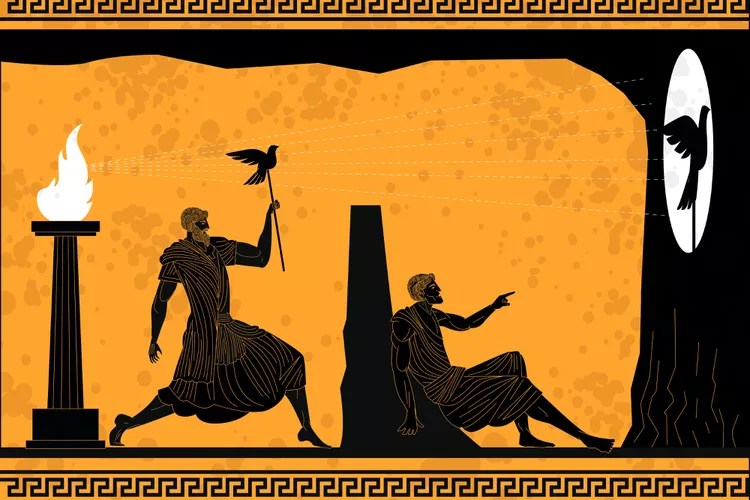
Plato claims that because the observers can only perceive the shadows of objects and not the objects themselves, they can never know the true forms of what they see.
It is then argued by Plato that while humans perceive various ‘shadows’ of ideas in our daily lives, such as the various kinds of chairs that exist, we can never truly perceive the true ideal of what a chair actually is.
While it seems silly to relate ancient Greek philosophy to modern science, the idea that humans are fundamentally limited in our ability to perceive reality has been a recurrent theme in modern science.
From Heisenberg’s Uncertainty Principle to Gödel’s Incompleteness Theorem, in the last century science has been confronted with the truth that it is unable to perceive reality perfectly.
This might lead one to ask why we even bother to practise science if we know it is fundamentally limited?
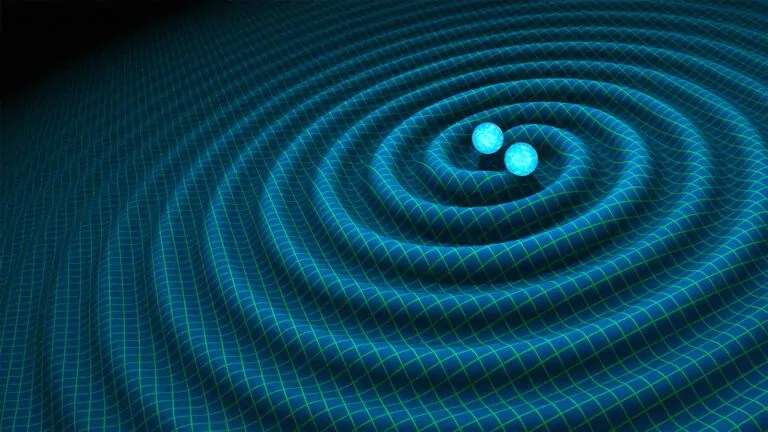
On the 14th of September 2015 the Laser Interferometer Gravitational-Wave Observatory (LIGO) detected gravitational waves created by the merging of two black holes 1.3 billion light years away from Earth.
LIGO managed to detect these gravitational waves by measuring a distortion in the fabric of space-time less than one thousandth the diameter of a proton.
By understanding the uncertainties inherent in their measurement, and taking steps the minimise them as much as possible, humans had managed to build an instrument sensitive enough to ‘hear’ the universe.
For our entire existence, humanity had only been able to use light to observe the night-sky. But now, we can actually hear the crash and roar of cosmic events that occur around us.
By understanding our limits and acknowledging our uncertainty, we can still perform wonders.
 The Dust Did Roar
Leave a comment